
Your posture greatly influences your emotional calmness by sending signals to your brain that affect stress levels and mood. Sitting or standing upright activates neural pathways linked to relaxation, lowers cortisol, and boosts confidence hormones like testosterone. Slouched positions, on the other hand, can increase anxiety and tension. Small adjustments like power poses or mindful alignment can markedly improve how calm you feel, and exploring more ways to optimize posture can enable even greater emotional resilience.
Key Points
- Upright, open postures activate brain regions that promote calmness and reduce stress hormones like cortisol.
- Proper posture strengthens neural pathways that regulate emotional responses, fostering emotional stability.
- Slouched positions impair breathing and circulation, increasing tension and anxiety levels.
- Power poses and confident stances temporarily boost testosterone and lower cortisol, enhancing mood.
- Regular posture adjustments and mindful positioning can significantly improve emotional regulation and calmness.
How Posture Influences Emotional States
Your posture plays a more significant role in your emotional well-being than you might realize. The way you hold your body influences your emotional states and mood through subtle signals sent to your brain. Upright, open postures are linked to feelings of calmness and emotional stability, while slouched positions can increase anxiety and stress. When you adopt confident postures, such as standing tall with shoulders back, your body language communicates control and strength, which can elevate your mood and reduce feelings of tension. Conversely, slumped or collapsed postures might reinforce negative emotions, making it harder to feel relaxed. Small adjustments, like sitting up straight, can have a surprisingly powerful effect on your emotional state. These postural cues help regulate your stress levels and boost confidence, creating a feedback loop where your body language directly influences how you feel inside. Paying attention to your posture can, *consequently*, serve as a simple yet effective tool for emotional regulation.
The Science Behind Posture and Stress Regulation
Research reveals that the way we hold our posture isn’t just about appearance—it has a direct impact on our brain’s stress regulation systems. When you maintain proper posture, neural pathways connecting your core muscles to brain regions involved in stress response get activated. This connection influences how your brain regulates stress hormones like cortisol, promoting calmness. Strengthening your core muscles sends calming signals through neural circuits that calm the sympathetic nervous system, reducing overall stress. Neural tracing studies show that muscles involved in posture have direct links to brain regions such as the cerebral cortex and limbic system, which are responsible for emotional regulation. By adopting upright posture, you stimulate these areas, fostering a biological foundation for calmness. Understanding this science highlights that your posture isn’t just structural—it’s a key player in how your brain manages stress, emphasizing the importance of mindful alignment for emotional well-being.
Physical Effects of Upright vs. Slouched Positions
When you adopt an upright posture, you activate physiological mechanisms that enhance lung capacity and oxygen intake, which in turn helps calm your nervous system. Proper spinal alignment supports nervous system function, reducing muscle tension and promoting relaxation. Conversely, slouched positions cause shallow breathing and increase muscle tension, heightening feelings of stress. Slumping forward diminishes circulation and stimulates stress-related neural pathways, raising cortisol levels and anxiety. Maintaining an open, upright stance not only improves breathing but also fosters a calmer state of mind. The table below summarizes these effects:
| Upright Posture | Slouched Position |
|---|---|
| Better lung capacity and oxygen intake | Shallow breathing and reduced oxygen |
| Reduced muscle tension and stress | Increased muscle tension and agitation |
| Supports nervous system and circulation | Hampers circulation, elevates cortisol |
Understanding these physical effects underscores how posture directly influences your stress response and overall calmness.
Posture’s Role in Hormone Balance and Mood
Adopting an upright posture doesn’t just improve breathing and circulation; it also markedly influences your hormone balance, which in turn affects mood and emotional stability. When you stand tall, your body activates hormonal pathways that promote relaxation and reduce stress. Conversely, slouched postures elevate cortisol, the stress hormone, leading to anxiety and emotional tension. Proper posture can boost testosterone levels, associated with confidence and mood stability, through nervous system modulation.
Consider these points:
- Power poses for two minutes can substantially raise testosterone and lower cortisol.
- Open chest positions stimulate relaxation hormones, easing stress.
- Slumped posture increases cortisol, heightening emotional tension.
- Upright posture enhances confidence by balancing mood-related hormones.
Practical Ways to Improve Posture for Calmness
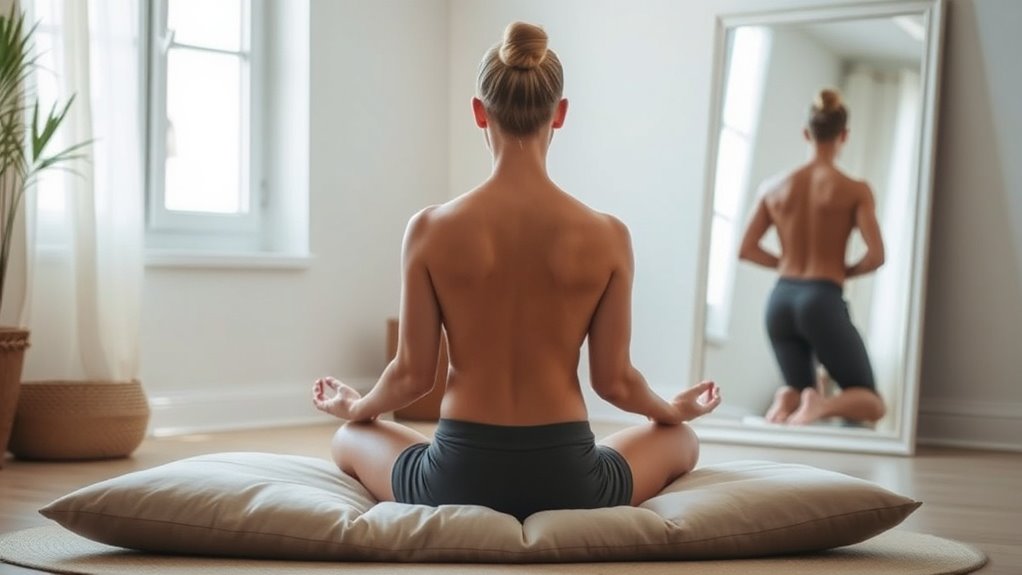
Improving your posture to promote calmness involves simple, intentional actions that can be integrated into daily routines. By consciously adjusting how you sit and stand, you influence both your body and mind, fostering relaxation and reducing stress. Practicing power poses, like standing tall with open arms for two minutes, can boost confidence and trigger hormonal changes that support calmness. Ensuring your workspace setup—such as aligning your monitor at eye level—encourages upright sitting, which lessens tension and cultivates a peaceful mindset. Regularly taking short breaks to stretch and reset your posture helps lower cortisol levels, enhancing relaxation. Additionally, becoming mindful of slouched or hunched positions signals to your brain that you’re calm and in control, easing anxiety. Incorporating posture-awareness activities like yoga and deep breathing further improves spinal alignment and encourages a balanced, calm body-mind connection over time.
The Connection Between Core Strength and Mental Resilience
Your posture doesn’t just affect how you look; it also influences your mental resilience. Strengthening your core muscles improves posture, which research shows can reduce anxiety and boost emotional resilience. Neural pathways link core muscle activity to brain regions that regulate stress responses, meaning a stronger core can help modulate your fight-or-flight reactions. Engaging in core-focused exercises like Pilates or yoga can also influence hormonal levels by increasing testosterone and decreasing cortisol, promoting calmness. Proper core strength supports nervous system function, directly enhancing mental health and resilience.
Consider these points:
- Improved posture from core strength reduces anxiety by stabilizing neural pathways.
- Strong core muscles connect to emotional regulation centers in your brain.
- Hormonal shifts from core exercises foster calmness and reduce stress.
- Better nervous system functioning enhances your capacity to cope with daily challenges.
Building core strength is essential—not just for physical stability, but for mental resilience too.
Tips for Maintaining Good Posture Throughout the Day
Maintaining good posture throughout the day is essential for both physical health and mental well-being, as prolonged poor alignment can lead to increased muscle tension and mental fatigue. To promote calmness through proper body alignment, keep your shoulders back and relaxed, ensuring your ears are aligned over your shoulders. Regular stretching every 20-30 minutes helps reduce muscle tightness and keeps your body centered. Adjust your workspace so your computer monitor is at eye level and your feet rest flat on the floor; this supports proper spinal alignment and prevents slouching. Incorporate deep, diaphragmatic breathing while maintaining good posture to enhance relaxation and decrease stress levels. Using reminders or apps to check and correct your posture throughout the day guarantees you stay upright and centered. Consistent attention to your body alignment fosters both physical comfort and mental calm, reinforcing the intrinsic link between posture and calmness.
Common Questions
What Are the Surprising and Powerful Links Between Posture and Mood?
Your body language, facial expressions, and even breathing patterns directly influence your mood. When you maintain an upright posture, make eye contact, and use open hand gestures, it signals confidence and calmness, reducing muscle tension and stress hormones like cortisol. These small adjustments can improve neural pathways involved in emotional regulation, helping you recall positive memories and feel more relaxed, demonstrating how posture and mood are intricately linked.
What Is the 555 Rule for Anxiety?
Think of the 555 rule as your mental anchor during turbulent seas. It involves breathing techniques—taking five deep breaths, holding each for five seconds—that activate muscle relaxation and grounding methods. This simple mindfulness practice reduces cortisol and promotes calmness. Visualization exercises and mental reframing reinforce a sense of control, helping you regain clarity and emotional stability quickly, making it an effective tool for managing anxiety in real time.
Is Bad Posture a Silent Killer?
Yes, bad posture can be a silent killer. It causes muscle tension and neck pain, disrupts breathing patterns, and triggers a stress response that impacts your confidence and energy levels. Over time, poor posture may worsen mental health, leading to increased anxiety or depression. Addressing posture through simple adjustments can reduce stress and improve overall well-being, highlighting its importance for both physical and emotional health.
What Is a Calm Posture?
A calm posture is like a secret superpower—imagine standing tall with relaxed shoulders, an open chest, and gentle muscle tension, signaling safety to your brain. Combining mindful awareness and ergonomic habits, you can enhance your breathing techniques and facial expressions, improving body language. This effortless stance reduces stress hormones and fosters deep relaxation, making you feel serene and grounded. It’s a simple yet powerful way to boost emotional stability every day.